
Classic Ice Flower
Six angular branching arms surround a broad center. This is the existing six-point ice-flower study.
 CHINESEpapercut.My purchases
THE PAPER SNOWFLAKE COLLECTION
Twenty sixfold designs, from branching snow crystals to hearts and flowers. Choose a printable, follow its folding guide, and turn one sheet into a winter decoration.
Free A4 & US Letter PDFs · SVG vectors · Non-commercial use


CHOOSE YOUR NEXT CUT
Start with broad branches, then try open windows, fine lace, or a floral paper decoration. Each design has its own cutting guide.
Six angular branching arms surround a broad center. This is the existing six-point ice-flower study.

Six broad arrowheads extend from short, strong stems. Large open notches give this snowflake a bold outline.

Six rounded lobes hold generous teardrop openings. The soft outer edge contrasts with the pointed ice-crystal designs.

Six hollow diamonds connect to a solid center through broad necks. Straight edges create an open geometric snowflake.

Three pairs of straight side twigs grow from each of six pine-like branches. The connected center keeps the open silhouette together.

Six wide arms end in deep V-shaped notches, with a narrow leaf opening in each arm. The split tips form a crown-like outline.
A continuous hexagonal frame connects to the center with six spokes. Large window openings reveal the frame and its six pointed corners.

Six lance-shaped leaves contain paired almond openings beside their central veins. The long leaves make a light, pointed snowflake.

Six scalloped fans contain branching curved openings. Rounded tips and broad fans give this snowflake a full decorative outline.

Six open main branches divide into shorter antler-like forks. Unequal branch lengths create a spacious silhouette without enclosed holes.

A scalloped outer wheel surrounds six radial teardrop windows and small round holes. Its continuous rim holds the delicate details together.

Three connected six-point star outlines form a layered crystal. Triangular gaps separate the rings while six spokes tie them together.

Six outward-facing hearts share a solid center. Each broad heart has a smaller heart opening, making a playful winter paper decoration.

Six short stems finish in three-pronged crowns. Small arched windows distinguish the wide crown tips from the solid central hub.

Six angular stepped branches surround a hexagonal center. Rectangular windows and square corners give the pattern a carved-ice appearance.
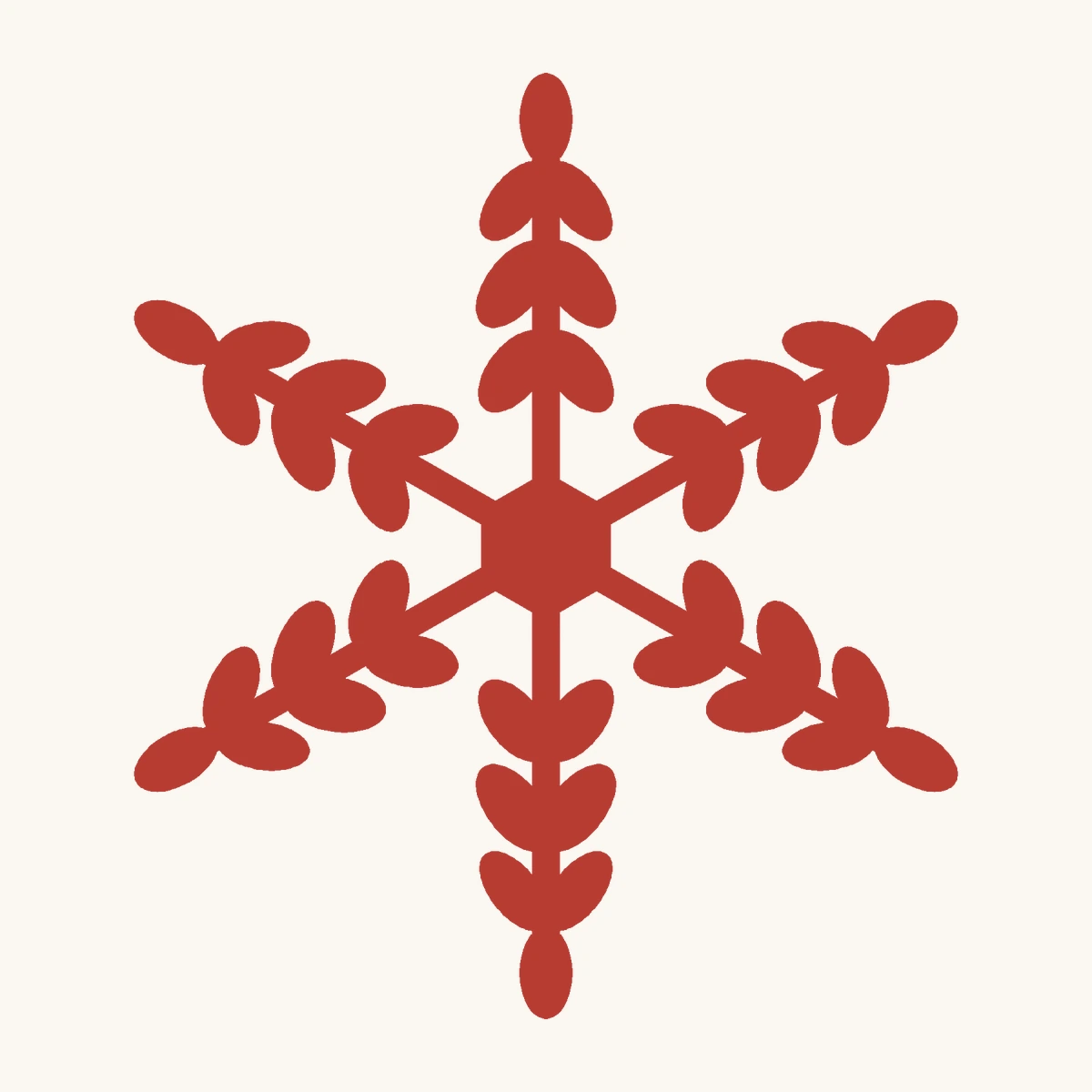
Six narrow stems carry pairs of rounded grain-shaped lobes. Deep open gaps between the grains create a distinct wheat-ear outline.

Six hexagonal lobes contain small honeycomb cells. Connected cell walls and a solid center form a crystalline lattice.

Six fan-shaped ginkgo leaves open around the center. A cleft at each fan tip and long radial slots emphasize the leaf shape.

Six long tapered icicles extend from a small hexagonal ring. Short side spikes and generous spaces make the silhouette sharp and open.
Six short branches end in connected five-petal blossoms, with a small bud on each side. It is a decorative snowflake arrangement, not a claim about a traditional motif.
Try a shorter search or another difficulty.
Difficulty labels are planning estimates. Check the cuts and tools on each template page; “Beginner” does not promise scissors-only cutting. Try a scrap before preparing a group activity.
MATCH THE CUTS TO YOUR TOOLS
Start with open edge cuts. Arrow Crystal has broad stems and clear notches. Pine Branch, Antler Branch, and Wheat Ear also have no enclosed holes, but their narrower tips and joins need more careful handling.
Practise keeping a frame intact. Try Diamond Crystal for straight sides around an opening or Hexagon Window for a continuous rim and spokes. Read the folded guide: an opening in the finished picture may be reachable from a folded edge.
Choose fine detail when you can work slowly. Lace Wheel and Honeycomb ask you to preserve repeated narrow connections. Inspect the working guide and access to each cut before choosing scissors or an adult-handled craft knife.
FROM FILE TO PAPER
Choose the PDF for hand cutting. Select A4 or US Letter to match the sheet in your printer. Designs 02–20 use the same 180 mm paper circle in either file. Their four pages contain the unfolded reference and circle outline, folding sequence, full-size working wedge, and cutting and opening notes. Page 3 is the sheet to trace onto folded paper; the small step pictures explain the process.
Keep each template’s pages together. Classic Ice Flower retains its original printable. Prepare the circle from its own page 1 and use its own page 3 guide; do not substitute a 180 mm blank or mix it with another design’s working wedge.
Print at 100% / Actual size. Turn off Fit to page and measure the 50 mm calibration line. If the measurement is wrong, fix the scaling before tracing. The folded tip and both straight edges should align with the full-size wedge. Never shrink the working guide separately from the paper outline.
Use SVG or PNG for artwork. The SVG is an unfolded vector design for editing or layout. Designs 02–20 also offer a PNG reference on their individual pages. Neither replaces the PDF’s fold sequence and working guide, and cutting-machine settings and compatibility have not been tested.
Make one paper trial. The final fold has twelve layers. Use thin paper that you can cut comfortably, keep the marked black connections, and remove the indicated waste. Stop if the stack shifts or a cut would cross a stem to reach a hole. Difficulty and time labels are planning estimates, not results from physical cutting trials.
Follow the folding diagrams and cutting tutorialBEFORE YOU BEGIN
Start with Arrow Crystal and follow its open edge cuts. A broad silhouette makes the retained stems easier to see. “Beginner” is a difficulty estimate, not an age recommendation or a guarantee that any folded paper will be easy to cut. Try the full fold on a scrap before preparing more sheets.
The full snowflake is the unfolded reference. Prepare the paper circle using the outline supplied with that design, fold it as shown, and trace the matching full-size working wedge. Do not place the whole snowflake picture onto a narrow folded wedge. Keep the circle and wedge at the same scale.
First check the 50 mm print line. If the size is right but the angle is wrong, check the folds: half, three equal angular sections, then half again. Every fold meets at the original circle center. If you have four or eight repeats, you used a different folding sequence. Reopen and refold before cutting; the folding diagrams show each stage.
A cut through a stem, rim, or narrow bridge can release a piece. Compare the break with the individual design’s keep-and-remove notes before trying again. Unequal arms can also come from uneven thirds or layers that slipped during cutting. Support the stack, align the edges, and turn the paper for corners instead of pulling the tips.
Start at the supplied size for the first trial. Reducing a pattern also narrows every paper bridge and makes small openings harder to cut. If you change the size, the circle outline and working wedge must use the same scale. Do not trace an unscaled guide onto a smaller circle; test one finished piece before making a set.
An adult should choose the design, check the folded thickness, and handle any craft knife work. Open edge cuts may suit a scissors activity, but twelve layers can still be difficult to cut. For a simpler introduction, start with the one-fold heart lesson. Allow time for folding and a trial instead of using the estimated cutting time as a class schedule.
Personal printing, classroom photocopying, and sharing the PDF/SVG files are allowed for non-commercial use. Commercial use is not allowed. Keep the matching guide pages together when handing out a pattern, and make one sample first to check your printer, paper, and available tools.
These downloads include each original pattern’s preparation and cutting sequence. The snowflake maker lets you add cuts to a preset or start with a blank wedge. Its print view gives a reference and matching working wedge for your edited design. Use that new wedge for custom cuts, and keep the original PDF for the unchanged pattern.
These are sixfold paper-craft designs. The branching crystals are snowflake-inspired; hearts, ginkgo leaves, and plum blossoms are decorative motifs. They are intended for making paper decorations, not identifying natural snow crystals.